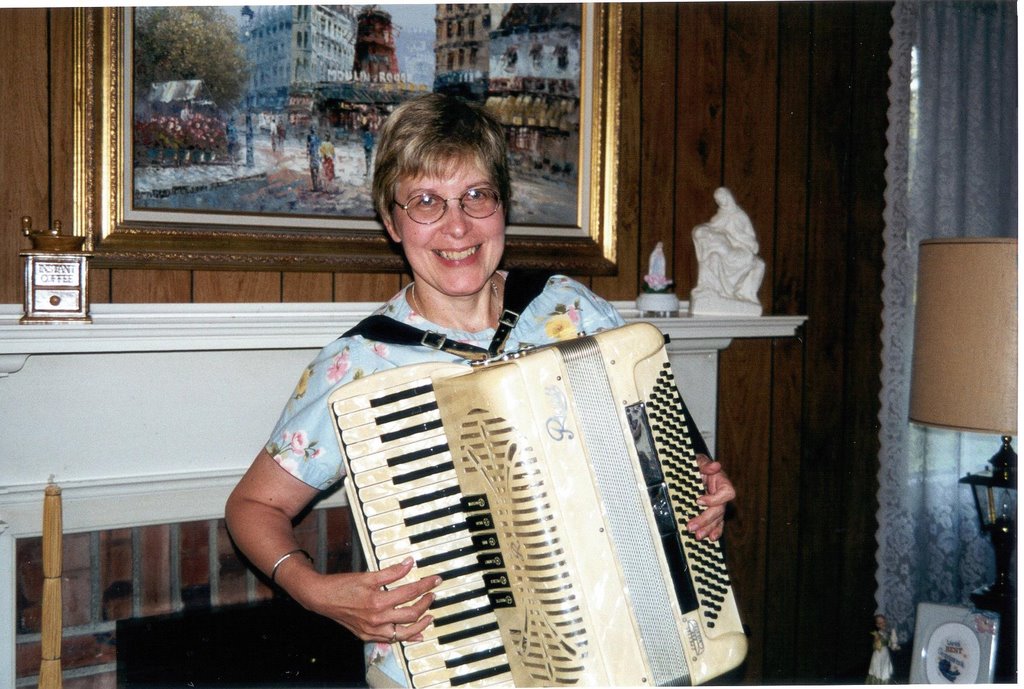
I seemed to awaken some longings for homegrown, do-it-yourself song and music when I came out of the closet with my accordion and shared some of my musical background. Thank you, readers, for the heartwarming comments.
Yes, I grew up with accordions and I'll share a secret: I think learning the bass (left-hand) side of the instrument actually gives a richer understanding of chord structure and theory than the piano. I transitioned to the foot pedals on organs so easily because my right brain was already set to "take the chord apart" and add my foot for a bass line. There’s also the touch of the instrument. Accordionists develop a different, softer style than pianists. You caress the keys more than hitting them. I like stroking things. The accordion is portable; the piano is not. It's a fun instrument and yet it's versatile too. There are virtuosos in jazz and even classical arenas. One of my male cousins is now in his 80s and the man can still play up a storm even with arthritis in his hands. He's my role model for senior jamming when the time comes!
My dad was a banjo man - four-string tenor and then electric tenor guitar. He made sweet music. We made sweet music together. He taught me a lot of the depression-era tunes, many of which were actually good foot-tapping music. Guess if you were working your way through the Great Depression, you had to keep up hope and write happy songs.
I still gravitate to the classics of the great pop composers: Gershwin, Kern, Porter and others who turned out some wonderful songs in the ‘30s and ‘40s. Their lyrics and melodies personified romance. The ‘50s brought new stylists and many lounge singers and crooners. Then the ‘60s produced those terrific Broadway musicals of Rodgers and Hammerstein, Lerner and Loewe, Leonard Bernstein and more. Superstars were born – grand dames of the musical stage like Mary Martin, Julie Andrews and Barbra Streisand. I got to see Streisand, front row center, in “Funny Girl”. Wow! I just think the 1930s through the 1960s were the golden age of American songwriting. The songs really told a message and gave hope and inspiration. Wouldn’t it be loverly if we had a new generation of fine pop music like that again?
And then there were the polkas. This was a genre all to itself. Learning how to play a polka (meaning lots of notes, fancy bass work, and very fluid and fast keyboard runs) got you promoted to the front of the class. As I wrote before, the accordion was the poor man’s substitute for the more expensive piano. Yet it challenged the musician every bit as much. Chopin played the piano as a master; wonder what he would have done with a good, folksy polka on the accordion?
Recently, I began to get this crazy idea … move on up to the Berkshires and start a polka band of my own. Who knows? If Lawrence Welk didn’t hire me (and I have the letter to prove it), then I may just have to go out there on my own.
If I do, then all of you who have forgotten instruments in your closets or new dreams of music lessons for yourself or kids, will have to follow my lead. Double dare?!